
Philip C. Johnson, October 31, 2026
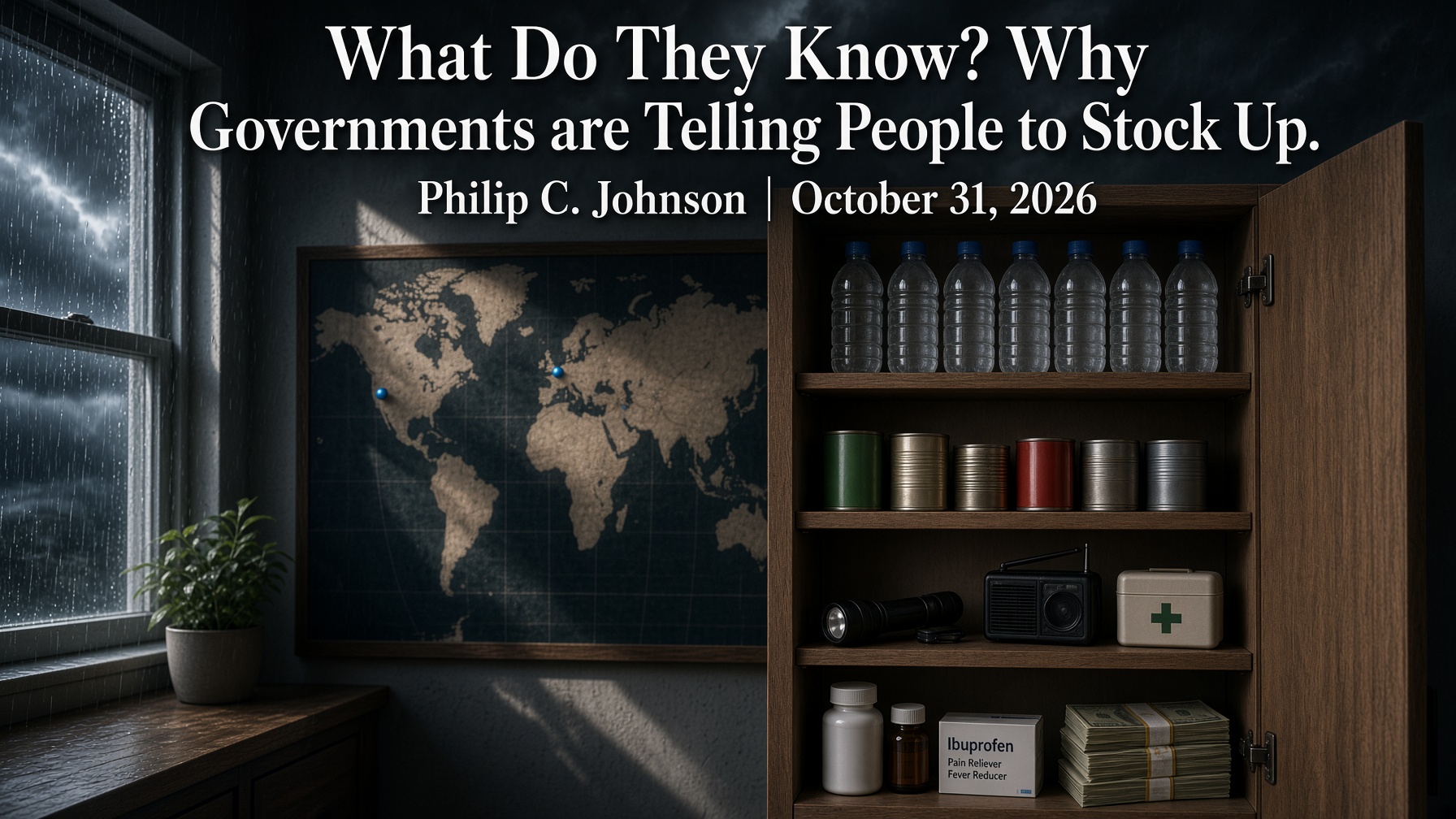
Listen to the instructions. Britain’s Be Ready campaign tells every household to keep three days of food, water, cash, medicine, a flashlight, and a battery radio. France’s Normandy region posted the plain version on October 27: “Do not wait for the emergency. Prepare now.” Japan will issue its own nationwide request on November 2 for at least three days, preferably a week, including emergency toilet supplies. Germany advises up to ten days. Sweden and Norway are in the same range. The United States has long maintained Ready.gov guidance and is now quietly requiring major military bases to operate for ninety days without outside power or fuel. The official explanations cite storms, cyberattacks, Russian hybrid activity, and the unfinished conflict with Iran.
That is a lot of governments, in a lot of places, saying roughly the same thing at roughly the same time. Household preparedness is not new. The coordination and the volume are. Podcasters like Tim Pool have started opening their shows with the straight reading of these government texts, the way a weather radio reads a tornado warning. The effect is the same: the language is calm, the implication is not. Is this the ordinary “always be prepared” message that civil defense offices have issued for decades, or have people inside those governments noticed something the rest of us have not yet named?
Europe is already answering part of the question on the streets. In France the autumn protests over school funding and the cost of living drew hundreds of thousands; the Interior Ministry put the largest day at roughly half a million. Italy’s “No Meloni Day” marches mixed student demands with fuel prices and living costs. In Spain, protesters have set up large tent camps over the housing shortage and rising rents. Albania has been boiling in Tirana. Germany has youth actions scheduled for the same weekend as France’s latest round. The grievances differ by country, but the underlying math does not: prices have outrun wages, public services feel thinner, and a large cohort of younger people has been told the system is basically sound while the grocery bill says otherwise.
Look closer at the faces in those crowds and a second pattern appears. A noticeable share of the protesters, especially the younger ones in France, Germany, Italy, and Belgium, are first-, second-, and third-generation immigrants who have not found a workable life in the West, or whose habits and expectations sit uneasily with the societies they live in. The marches are not a single coordinated uprising, but the failure of assimilation is part of the story.
Poland is running its own version of the same friction, this time inside the courthouse. On Friday judges aligned with the current government suspended the head of the Constitutional Tribunal, the country’s top court that decides whether laws match the constitution. The suspended judge is a holdover from the previous administration. Riot police moved in. The opposition called it a coup. The president cut short a foreign trip and flew home. Both sides claim they are the ones defending the constitution. This sort of disorder is the kind of thing neighboring countries notice.
The American midterms arrive on November 3. Republicans hold thin majorities in both chambers. Democrats need only a handful of House seats and four in the Senate to take control for the second half of Trump’s term. Early voting is already heavy. Whatever the numbers, the result will not resolve the issues that separate the nation. It will only decide how much friction the White House faces while those issues remain polarizing.
One of them is the war with Iran, now in its eighth month. It began in late February with joint American and Israeli strikes that killed the Supreme Leader and a string of senior figures. An April ceasefire and a June memorandum of understanding both unraveled. What remains is a naval blockade and counter-blockade around the Strait of Hormuz, tanker attacks, elevated oil prices, and a diplomatic track that keeps moving without producing a deal. Trump has said the United States will not resume major strikes before the midterms. He has also said a ramped-up campaign is possible afterward, and the Pentagon has been told to finish preparing usable options for him. Gulf states have been warned to prepare for a short, intense round.
American intelligence has warned that Iranian plots against U.S. personnel have reached advanced stages, and European services have been tracking related activity. Officials on both sides of the Atlantic have spoken openly about the risk of sleeper cells or local operatives already in place, people living ordinary lives until they are activated. Whether any of that materializes on a timetable is the sort of thing that becomes clear only after the fact. The capacity and the incentive are not imaginary.
Israel’s election on October 27 produced the classic non-result: Netanyahu’s bloc at 53 seats, the main opposition around 48, Arab parties at 19. No one reached 61, the number you need for a coalition government. Coalition talks will drag on while the same regional files stay open. An election that was supposed to clarify the country’s direction has mainly clarified that the arithmetic is still stuck.
Set the pieces next to one another and the pattern is hard to miss. Households from Tokyo to London are being told to keep a week’s worth of food. Streets in half a dozen European countries are testing how much disorder the authorities will tolerate, and who is doing the testing. A major European democracy is arguing over who controls its highest court. The United States is days from an election that could change the balance of power in Washington. An active war in the Gulf is on pause only until the ballots are counted. People who follow these things have started using older language: end-times, apocalyptic, the sense that the ordinary calendar is running out of ordinary months. Some of that is always present; the internet makes it louder. Some of it is the reasonable reaction to several systems that look more brittle than they did a few years ago.
The boring explanation is still available. Governments have known for years that cyberattacks, extreme weather, and great-power friction can cut off normal services for days. Telling people to keep a few days of basic supplies is cheaper than explaining why the lights stayed off. European living standards have been under pressure since the energy shock that followed the invasion of Ukraine; the protests are the delayed expressions that have been brewing beneath the surface for years, and the composition of the crowds is the delayed demographic invoice that has been left unpaid for far too long. Poland’s judicial fight is the unfinished business of a decade of contested appointments. The Iran war is expensive, unfinished, and politically awkward for a president heading into midterms, so the obvious move is to keep the shooting low until the votes are in. None of that requires a secret calendar.
The less boring reading does not require a secret agenda either. It only requires noticing that the number of simultaneous stress points has gone up, that the people whose job is to notice those points are acting as if the next one might not be small, and that ordinary citizens are already living with higher prices, thinner services, and the low-level background noise of possible escalation. Preparedness is not a prediction. It is an admission that the margin for error has narrowed. Whether someone in a capital knows something or is simply doing the larger calculus in public is almost beside the point.
For a Christian who still believes God is on His throne and unsurprised by any of this, the practical difference is simpler. You can live a forward-looking life without turning every headline into a private burden. You stock the water and the medicine and the cash because that is ordinary wisdom. If the unexpected comes, you will not be starting from zero. If it does not, you will eat canned spaghetti for a few weeks and laugh about it later. The deeper work is the same either way: keep your house in order, love the people nearest you, and refuse to let the what-ifs steal the ordinary days that are still yours.
I will be in Paris with a student group at the end of the first week of November, then in Scotland with another. Like a lot of people, I am curious what the locals are actually saying about this age of anxiousness once the cameras and the headlines move on. The same days that make governments issue stockpile lists are also ordinary days in which a conversation can turn, and the best thing a person can offer is not another forecast. It is the older news that the One who sits on the throne already knows the whole calendar, is still kind, and is carrying out a redemptive plan for the people He made. The rest of the story will write itself soon enough.


It is interesting that the sitting President’s party has lost seats in Congress every time for the last 80 years or so. The results of the midterms is no cause for panic on one side not celebrating on the other. The question is how fast will the Democrats file articles of impeachment and waste time and energy while the Social Security solvency issue is looming along with many other issues that need to be addressed. God is on the throne so we need fear no man. Press on brother.
Mid terms are predictable. But I agree, the wasted time trying to impeach Trump takes away from everything else that our elected officials are there to do.