
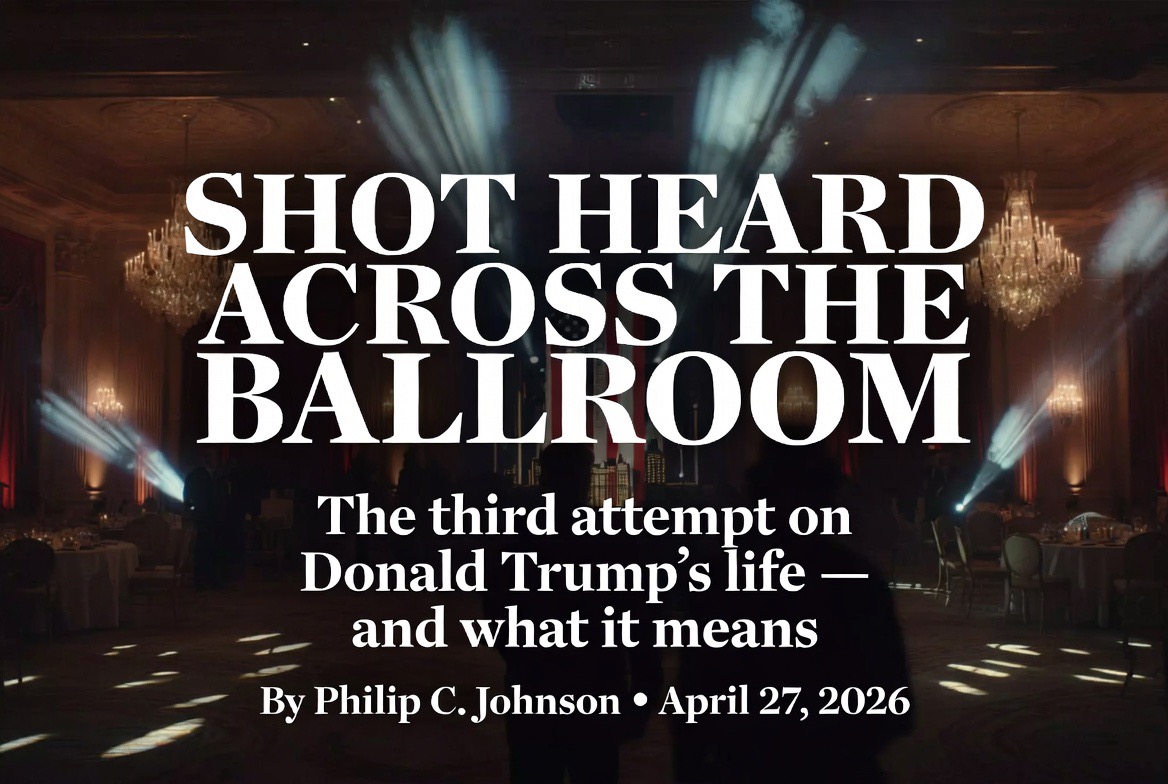
By Philip C. Johnson—April 27, 2026
Saturday Night at the Hilton
The White House Correspondents’ Dinner is supposed to be Washington’s annual truce — journalists and power sharing a meal, a few laughs, and the polite fiction that they don’t despise each other. On Saturday night, April 25, at the Washington Hilton, that fiction died in a hail of gunfire.
A Secret Service officer was struck by at least one round — saved only by a bulletproof vest. President Trump and First Lady Melania were evacuated from the ballroom. Trump, composed (as always) in the aftermath, told CBS’s Norah O’Donnell: “I’ve been through this before a couple of times. She has not, to this extent.” He was right. It wasn’t his first rodeo. It was his third.
The Man and His Manifesto — Call It a “Festo-Lite”
Cole Tomas Allen, 31, a mechanical engineer and educator from Torrance, California, charged a security checkpoint outside the ballroom armed with a shotgun, a handgun, and multiple knives.
He left behind a written statement — officials call it a manifesto. Given its brevity and its grandiosity, I think the term “festo-lite” might be more accurate. In it, Allen referred to himself as the “Friendly Federal Assassin” and declared he was “no longer willing to permit a pedophile, rapist, and traitor to coat my hands with his crimes.” Acting Attorney General Todd Blanche told NBC’s Meet the Press that Allen appeared to have set out to target administration officials, likely including the president. Allen is not cooperating with investigators.
He was charged Monday in federal court with three counts: attempting to assassinate the president, using a firearm during a crime of violence, and transporting a firearm across state lines with intent to commit a felony.
The Security Gaps
Security camera footage showed Allen running past officers who were in the process of dismantling metal detectors — standard procedure once the president was seated and the secured area closed to new arrivals. Allen had been a guest at the hotel, checking in the day before.
Rep. James Comer, Chairman of the House Oversight Committee, called the breach a direct result of insufficient DHS funding and demanded a Secret Service briefing, noting that the agency had gone unfunded for more than 70 days. Secret Service Director Sean Curran called the multilayered protection a success. Both statements can be simultaneously true — and that’s the problem. A distinctly “Washington DC” problem.
Trump himself noted that the Washington Hilton “was not a particularly secure building” — a fair assessment of a public hotel hosting the leader of the free world.
The Bigger Picture: Target in Plain Sight
This was the third confirmed assassination attempt on President Trump — fourth if you count the Iranian regime’s 2024 murder-for-hire plot, in which an IRGC-trained operative arrived in the U.S. in April 2024, met with undercover federal agents posing as hitmen, and was arrested in July 2024 before leaving the country.
My friend Blake makes a point worth taking seriously: Trump may be the most publicly visible president in American history. In his second term, social media content is increasingly linked to governing itself — a relentless, omnidirectional presence across Truth Social, X, rallies, press availabilities, and prime-time addresses. That visibility is strategic and deliberate. It is also a liability that the Secret Service’s current protection model was never designed for. If Blake is right — and the evidence suggests he is — the calculus of presidential security needs a fundamental rethink.
What This Means
Three attempts. Possibly four. A sitting president who refuses to govern from behind bulletproof glass. A political climate in which a 31-year-old engineer with a Caltech degree and a festo-lite decides he’s the arbiter of justice. The pattern is no longer deniable: four attempts on one president, each rooted in a hatred stoked by a culture that has confused political rage with righteousness.
For the country, that should be a sobering moment of self-examination. And it raises a harder question: Can America protect a commander-in-chief who has made radical visibility a defining feature of his leadership — and who shows no interest in changing that?
History is watching. So, apparently, is the wrong kind of audience.
 The Global Nexter