
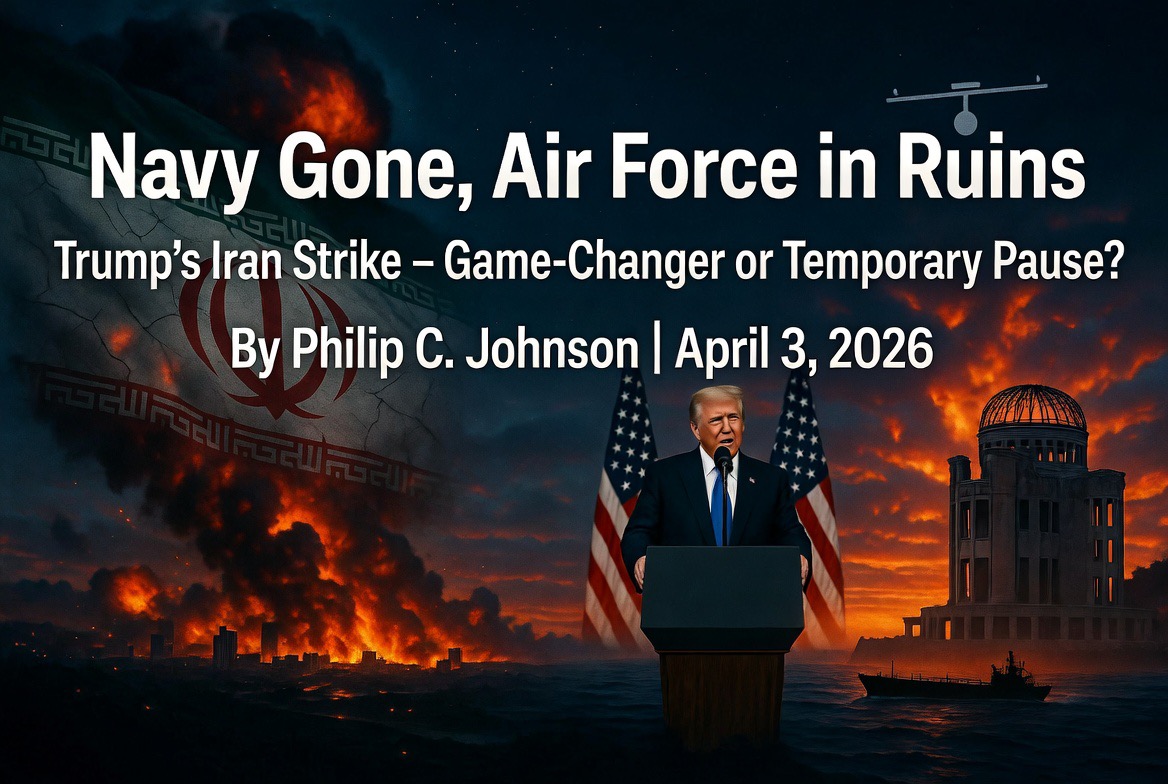
By Philip C. Johnson | April 3, 2026
I’ve spent the last month in Hiroshima, Japan, with U.S. students studying global conflict from a Christian perspective. Standing at history’s most famous Ground Zero while another unfolds in real time sharpens the mind. Now back home—briefly—it’s worth asking the oldest question in warfare about the U.S.-Israeli campaign in Iran: Did we just deliver a decisive blow, or merely hit pause?
The Campaign Unfolds
The roots were clear and long overdue. Iran had spent years arming proxies, striking U.S. forces, and racing toward nuclear breakout. On February 28, President Trump launched Operation Epic Fury, a joint campaign to eliminate nuclear latency, destroy ballistic missiles, cripple the navy, and degrade terror networks.
The results were swift and brutal. American and Israeli forces struck more than 11,000 targets, gutting missile stockpiles and factories, sinking major naval vessels, and suppressing air defenses so completely that non-stealth aircraft later flew with near-impunity over Tehran. Iran’s retaliation—attempting to close the Strait of Hormuz and firing missiles at regional targets—briefly spiked oil prices near $100 per barrel. But its counterattacks collapsed rapidly.
In the opening strikes, Supreme Leader Ali Khamenei was killed along with several family members. His son, Mojtaba Khamenei, was quickly named successor by the Assembly of Experts and is now Iran’s supreme leader on paper. Yet Mojtaba has made no public appearance or video statement since the conflict began. Iranian and Russian sources claim he is alive and directing from a secure location, with his absence blamed on wartime security. U.S. officials, including President Trump, have expressed uncertainty, noting the lack of verifiable proof of life or active command. Speculation about the severity of his reported injuries—or even whether real power rests with him, the IRGC, or a hardliner council—continues amid the fog of war.
In his blunt April 1 primetime address to the nation, Trump declared: “Tonight, Iran’s navy is gone. Their air force is in ruins. Their leaders, most of them terrorists—the regime they led—are now dead.” Thirteen American service members have been killed and 348 wounded. Iranian casualties remain hotly contested but undeniably significant. Notably, there was no U.S. ground invasion—no quagmire, just precision strikes.
Europe’s Familiar Hedge
Europe condemned Iranian aggression but declined to join offensive operations. Trump sharply criticized NATO allies for refusing to share the burden and said he is “absolutely” considering withdrawal from the alliance. The pattern persists: America acts decisively; Europe hedges and issues statements.
What Comes Next
Iran’s president has signaled interest in a ceasefire. Trump’s reply was characteristically direct: the U.S. will consider it when the Strait of Hormuz is “open, free, and clear.” Tehran publicly denies talks—a classic regional diplomatic two-step. Trump has downplayed immediate worry over buried highly enriched uranium, citing constant satellite monitoring.
Two wild cards remain under-discussed. First, Tehran may have activated sleeper networks for asymmetric strikes on soft targets worldwide. Second, China—buyer of over 90% of Iran’s oil—has substantial stockpiles and could quietly resupply Iran through shadow channels, risking broader escalation.
The Oldest Question
Iran has proven resilient before. Russia and China stand ready to offer sanctions relief and technical aid the moment pressure eases. The new leadership—battered, possibly fractured, and fronted by an unseen supreme leader—now faces a stark choice: pragmatism and survival, or the old ideological grievance.
This campaign degraded capabilities and bought strategic time in ways sanctions and diplomacy never could. Whether it produces lasting change depends on Tehran’s fractured councils and whether its external backers can resuscitate the regime faster than expected.
In Hiroshima last week, I kept returning to the belief that one overwhelming use of force could end a war and reshape the world. Sometimes it does. Sometimes it only changes the shape of what comes next. The coming weeks—post-Trump’s address—will tell us which kind of moment this truly is.
Philip C. Johnson is an educator, journalist, geopolitical analyst, and founder of Global Next (globalnext.org), an educational travel organization operating across Europe, Asia and the Middle East.
 The Global Nexter