
By Philip C. Johnson
January 21, 2026 – Tel Aviv
In the third week of January 2026—amid mounting signs of internal strain within Iran’s regime and the formal launch of Phase 2 of the Israel–Gaza ceasefire on January 14—I traveled to Israel to speak directly with those who have shaped, and continue to shape, the country’s national security thinking.
Phase 2 of the ceasefire, outlined by U.S. Special Envoy Steve Witkoff under President Trump’s 20-point framework, shifts emphasis toward Hamas demilitarization, transitional technocratic Palestinian governance, and reconstruction. Yet as events continue to unfold, the gap between diplomatic design and strategic reality remains wide.
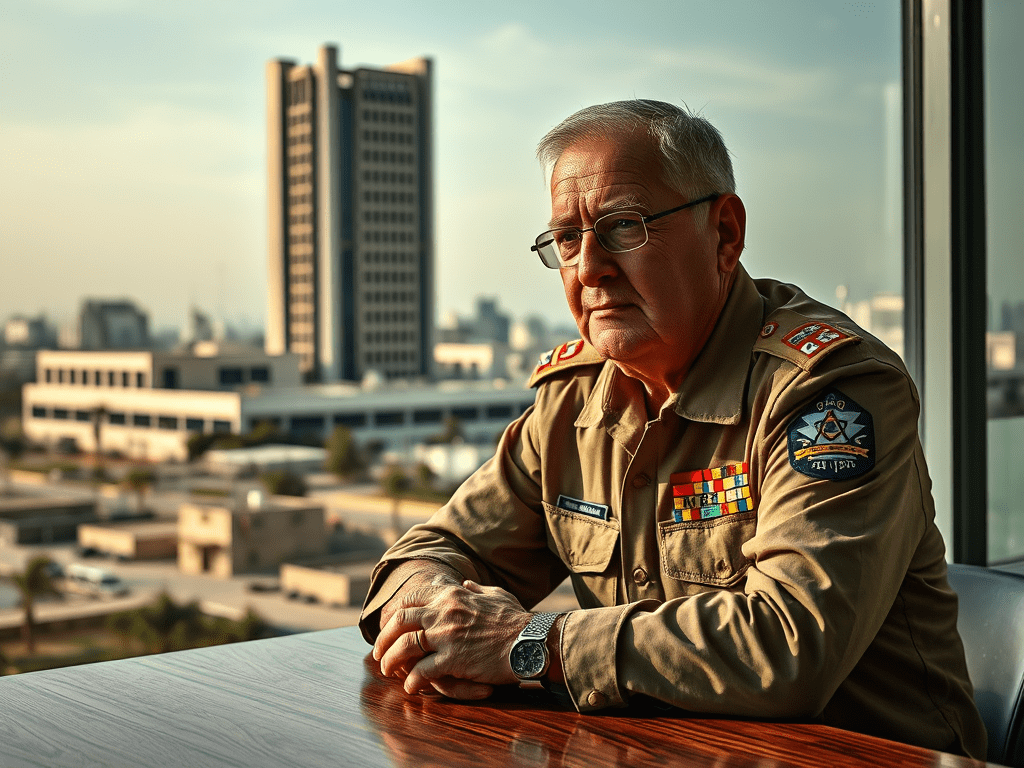
To better understand those realities, I sat down in Tel Aviv with Major General (ret.) Amos Yadlin, one of Israel’s most experienced and respected security figures.

Yadlin’s credentials are unimpeachable. A former Israeli Air Force fighter pilot with more than 5,000 flight hours and over 250 combat missions, he was one of the eight pilots who carried out Operation Opera in 1981, destroying Iraq’s Osirak nuclear reactor under Prime Minister Menachem Begin. In 2007, as head of the IDF’s Military Intelligence Directorate (Aman), he played a central role in the strike that eliminated Syria’s covert nuclear reactor. He later served as Deputy Commander of the Israeli Air Force, Chief of Military Intelligence from 2006 to 2010, and subsequently led the Institute for National Security Studies (INSS). Today, he heads MIND Israel, advising governments and institutions on national security strategy.
As we spoke, we looked out over the Kirya, Israel’s central defense complex—often referred to as the country’s Pentagon. The Matcal Tower and surrounding buildings still bore visible damage from Iran’s ballistic missile barrages in June 2025, a reminder that Israel’s strategic challenges are no longer theoretical.
The Gaza Ceasefire: Phase 2 and the Demilitarization Dilemma
Yadlin began by contrasting the clarity of Phase 1 with the ambiguity of Phase 2.
“I think the 20 points of President Trump has two stages,” he explained. “The first stage had very, very clear parameters—numbers, timelines, lines of withdrawal. The second stage has ambiguities. It is very bland. It allows different interpretations from both sides.”
Phase 1—hostage releases, Israeli withdrawal to defined lines, and a ceasefire—was executed, as Yadlin noted, “almost to the point, without one missing fallen policeman.” Phase 2, however, leaves unresolved tensions at its core: Israel prioritizes demilitarization, while Hamas emphasizes reconstruction.
Yadlin outlined three plausible scenarios:
- Minimal compliance by Hamas, surrendering heavy weapons while retaining light arms and operating under the cover of a “legitimate” governing structure—mirroring Hezbollah’s model in Lebanon. Yadlin said he hopes President Trump rejects this outcome but acknowledged the president’s desire for a historic diplomatic legacy.
- Escalation with U.S. backing, should Hamas fail to meaningfully disarm. As Yadlin put it, if Hamas does not comply diplomatically, “it will be achieved the soft way or the hard way,” meaning military force may follow diplomacy.
- A divided Gaza, reminiscent of post–World War II Germany: a terror-free zone under Israeli control where reconstruction proceeds, and a separate area left under Hamas influence. Yadlin was blunt: “I’m not sure this is a sustainable model.”
On one point, however, he was unequivocal:“For Israel, letting Hamas rebuild is not an option. Seven of October will never happen again.”
International Forces and Strategic Reality
Much has been made of a proposed multinational stabilization force to oversee Gaza’s transition. Yadlin expressed little confidence.
“I didn’t see the mandate. I didn’t see the budget. And I don’t see the countries that want to fight Hamas,” he said. “You see Indonesians or Egyptians that want to fight Hamas? I don’t.”
His conclusion was stark: “On the security of Israel, I don’t rely on that. I rely on Israel. I rely on the IDF.”
October 7: A Tri-Lateral Failure
Drawing on his experience as both a young pilot during the Yom Kippur War and later as Israel’s intelligence chief, Yadlin described October 7, 2023, as a “tri-lateral failure”—intelligence, operational, and political—worse in civilian impact than Pearl Harbor or 1973. (Yom Kippur War)
- Intelligence failure: misplaced priorities (Iran and Hezbollah over Hamas), cultural rigidity, and an inability to challenge entrenched assumptions.
- Operational failure: failure to raise readiness despite known internal divisions within Israeli society.
- Political failure: empowering Hamas with Qatari funds, sidelining the Palestinian Authority, and projecting weakness.
He highlighted the most damning revelation: Israeli intelligence possessed Hamas’s operational blueprint—the “Wall of Jericho” plan—as early as 2018.
“They had the plan. They bought the plan. And they ignored it,” he said. “They said Hamas would never do it. That was a huge mistake.”
Yadlin contrasted this with his own leadership philosophy, recalling an email he sent to all 15,000 intelligence personnel inviting dissent: “Nine out of ten were wrong. But one out of ten times might save lives.”
Why “Absolute Victory” Remains Elusive
Yadlin rejected the notion that Israel could achieve total victory over Hamas.“There are four reasons why absolute victory cannot be achieved,” he said.
“The hostages, the tunnels, Hamas’s willingness to sacrifice its own people, and the price Israel pays in its standing in the world.”
With hostages now largely returned and new operational techniques developed, the objective has shifted: preventing Hamas from rebuilding a terror army capable of repeating October 7.
Iran: The Core Strategic Challenge
For Yadlin, Iran—not the Israeli-Palestinian conflict—is the central destabilizing force in the Middle East.
“Iran is financing, arming, and training all the bad guys around us,” he said, naming Hezbollah, Hamas, the Houthis, and Islamic Jihad.
He cautioned against overconfidence regarding Iran’s internal unrest, noting that regime collapses—from the Soviet Union to Mubarak’s Egypt—are notoriously unpredictable.
Still, he assessed that neither Iran nor Israel is likely to initiate war in 2026 unless the United States acts first. Any U.S. strike, he argued, should be calibrated to assist internal opposition rather than merely punish the regime.
Deterrence, History, and the Limits of War
Yadlin anchored Israel’s strategic outlook in the ideas of Ze’ev Jabotinsky’s “iron wall” and David Ben-Gurion’s “rounds” theory.
“Israel needs to win every round,” he said. “But it will not be an absolute victory. It will give deterrence for another ten years.”
In a line that crystallized the interview, Yadlin observed: “Finishing the job was last done in 1945. What was acceptable in 1945 is not acceptable in 2025.” Deterrence, he warned, always has an expiration date.
From the scarred Kirya in Tel Aviv to Gaza’s uncertain future and Iran’s simmering volatility, Yadlin’s realism offers little comfort—but substantial clarity. Israel’s challenge, he made clear, is not to seek final victories, but to learn, adapt, deter, and survive in a world that no longer permits decisive ends.

 The Global Nexter