
By Philip C. Johnson, July 7, 2025
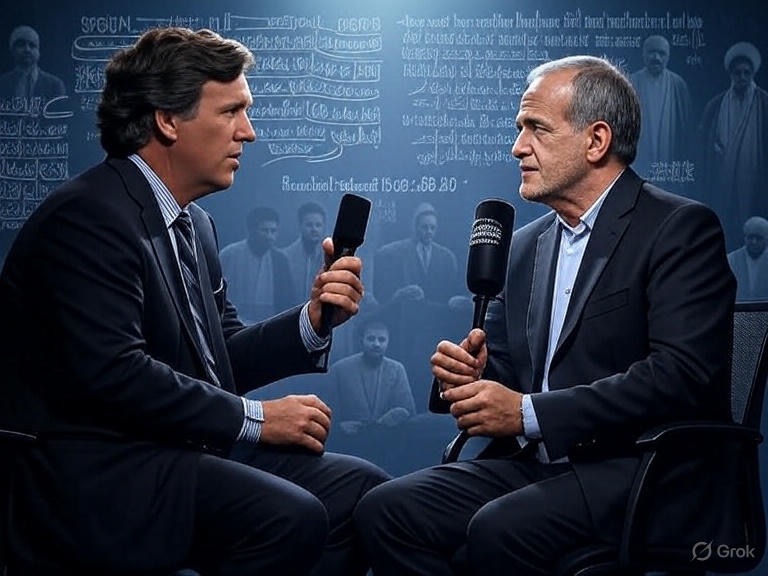
This morning, July 7, 2025, Tucker Carlson aired a controversial interview with Iranian President Masoud Pezeshkian on his YouTube channel, igniting debate over platforming a leader from a nation hostile to the United States. Pezeshkian portrayed Iran as a peace-seeking nation unfairly targeted by the West, and Carlson’s failure to robustly challenge these claims risks amplifying Tehran’s propaganda. The interview, met with polarized reactions on social media, reveals how some viewers naively accept Iran’s narrative, turning criticism toward the U.S. and Israel instead of scrutinizing a regime with a track record of aggression.
Pezeshkian claimed Iran has no interest in nuclear weapons, insisting its nuclear program is peaceful. This is dubious. Iran has enriched uranium to 60%, far beyond civilian energy needs and close to the 90% required for weapons-grade material. The International Atomic Energy Agency (IAEA) confirms Iran’s stockpile of 60% enriched uranium positions it as a “nuclear threshold” nation, capable of producing a nuclear weapon in weeks. Japan shares this threshold status, but Iran’s refusal to allow full IAEA inspections fuels suspicions of its intentions. Carlson’s lack of pushback allowed Pezeshkian to downplay this threat, potentially misleading viewers about Iran’s nuclear ambitions.
Equally troubling was Pezeshkian’s claim that Iran seeks peace, which contradicts the regime’s rhetoric. Iranian leaders, including Supreme Leader Ali Khamenei, have long branded America the “Great Satan” and chanted “Death to America.” A June 2025 video showed Iranian parliament members burning a U.S. flag while echoing these slogans. Pezeshkian claimed these chants are misinterpreted, merely meaning “death to bullying” rather than hostility toward Americans. This is absurd, as the phrase’s context, coupled with Iran’s actions, clearly targets the U.S. as an enemy. This hostility is rooted in core Islamic teachings cited by Iran’s theocracy, which frame non-Muslims as adversaries. Surah Al-Ma’idah (5:32) is often quoted to suggest Islam’s peaceful nature, stating that saving one life is like saving humanity. Yet, Surah 5:33 prescribes death, crucifixion, or mutilation for those who “wage war against Allah and His Messenger” – a category including non-Muslims resisting conversion. This theological call for global conquest underpins Iran’s aggression, contradicting Pezeshkian’s claims. Carlson’s failure to challenge this allowed a sanitized narrative to stand.
Pezeshkian’s assertion that Iran has never killed any Americans is flagrantly false. Iran’s proxies, notably Hezbollah and Iraqi militias, have caused numerous American deaths. The 1983 Beirut barracks bombing, orchestrated by Hezbollah with Iranian backing, killed 241 U.S. service members. Since 2003, Iran-backed groups like Kata’ib Hezbollah have been responsible for hundreds of U.S. military deaths in Iraq, including a 2020 drone strike that killed two American soldiers. The U.S. Defense Department attributes over 600 American casualties to these groups by 2020. Probably a conservative number. Carlson’s lack of pushback on this denial risks whitewashing Iran’s role in these attacks.
The X responses to the interview underscores how gullible some audiences are, with certain posts swallowing Pezeshkian’s narrative and redirecting anger toward the U.S. and Israel. One user (@SputnikInt) wrote, “Iranian President Masoud Pezeshkian’s interview with Tucker Carlson exposes growing US backlash against neocons’ ‘Israel-First’ agenda,” framing Iran as a victim and the U.S. as a warmonger. Another (@SunLight__White) praised Carlson, claiming, “Tucker’s right to give Iran a voice – America and Israel are the real aggressors here.” These reactions reveal how the interview fuels anti-American and anti-Israeli sentiment, with some viewers uncritically accepting Pezeshkian’s claims despite Iran’s documented hostility.
Carlson’s decision to platform Pezeshkian, as a journalist and commentator, raises concerns about amplifying an adversary’s voice. Iran is not just a “rival” nation – it is an enemy nation. Iran remains a state sponsor of terrorism, supporting groups targeting American and Israeli interests. Giving Pezeshkian an unchallenged stage risks legitimizing his narrative, as seen in X posts criticizing the U.S. and Israel. Following U.S. and Israeli strikes on Iranian nuclear sites like Fordow in June 2025, such platforming could embolden adversaries and confuse public perception. X users like @AndrewGhalili called it a “gift to the regime in Iran,” noting Carlson’s soft approach handed Tehran a propaganda win.
While open dialogue has value, journalists must challenge falsehoods, especially from hostile regimes. Carlson’s interview, by failing to counter Pezeshkian’s claims about Iran’s nuclear program, peaceful intentions, and American deaths, risks advancing Tehran’s narrative. Iran’s 60% uranium enrichment, anti-American rhetoric, and proxy attacks demand rigorous scrutiny. A free press should not mean a free pass.

