
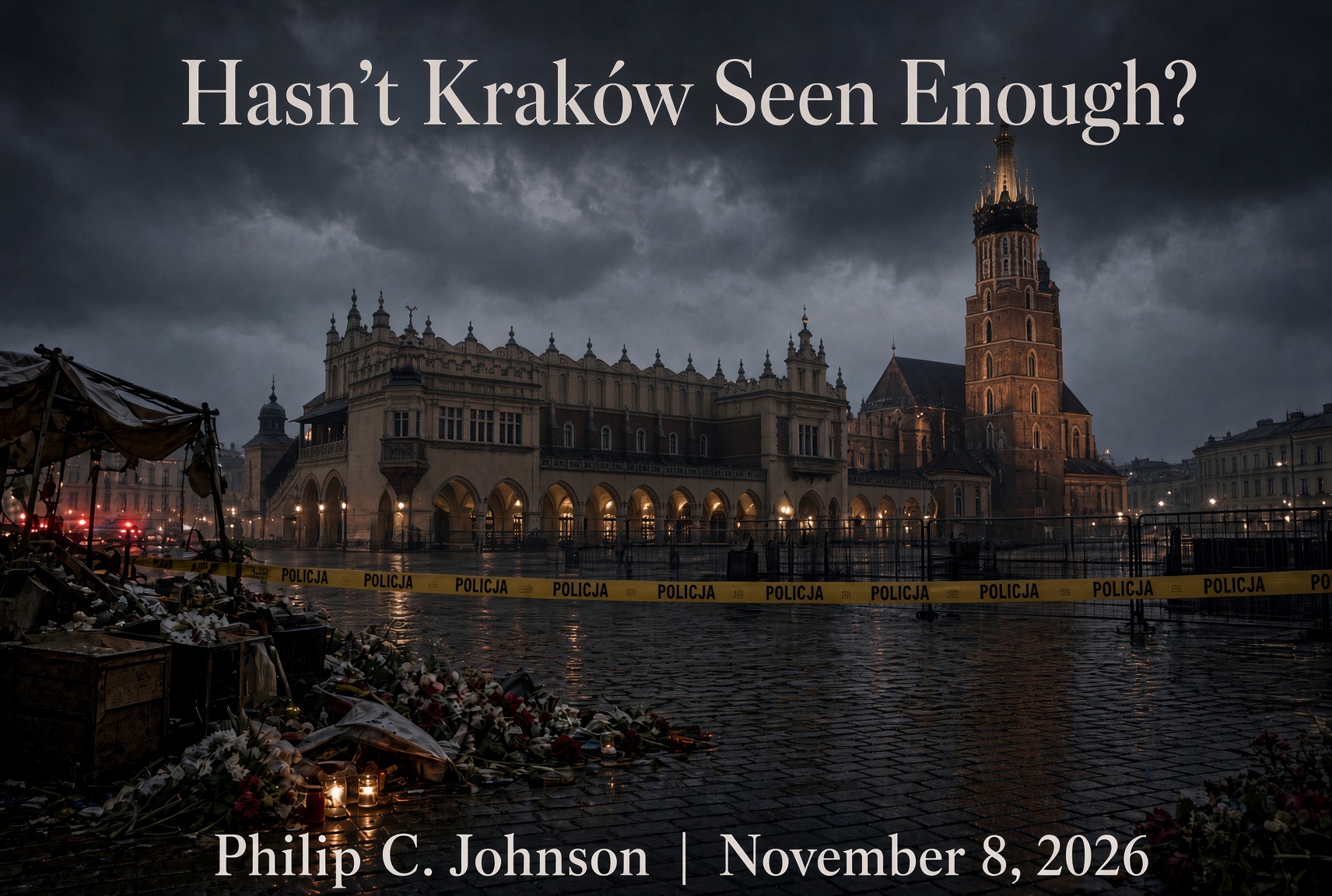
By Philip C. Johnson, November 8, 2026 (reporting from Paris)
The breath of Auschwitz still whispers the names of the Jews murdered there, more than a million souls reduced to ash and memory in the camps just an hour away. The city itself carries the weight of occupation, of the wartime ghetto, of centuries of hard history beneath its medieval stones. And yet, for those of us who return, Kraków has also been a place of unexpected light. Global Next has brought groups there again and again. We have walked the cobblestones of the Rynek Główny, the Main Market Square, one of the loveliest in Europe, past the permanent flower stalls of the Kraków flower sellers, under the long arcade of the Cloth Hall, and near the trumpeter’s tower at St. Mary’s, where the air is full of café chatter and the slow turn of the square’s life. It is a place that feels, for a while, like ordinary European beauty still intact.
Now it has been bloodied. On Saturday afternoon, around three o’clock, a 24-year-old Polish man drove into that same square in military-style clothing and a ballistic vest. He opened fire with an automatic weapon as he moved through the open space, shooting at random among the tourists and locals. Six people were killed, four women and two men, including a British man and an Austrian woman. Roughly sixteen others were wounded, among them visitors from Britain, Austria, Germany, Portugal, and Russia, as well as two police officers. One officer who confronted him was seriously hurt. The attacker was shot and wounded by police and remains in critical condition. Later, the bodies of his parents and younger sister were found at the family home in Ostrowiec Świętokrzyski, dead from gunshot wounds. Authorities say the man held radical, ultra-nationalistic views and was fascinated by far-right ideology. Prosecutors have opened an investigation treating the attack as a terrorist offence. Poland has entered a period of national mourning. Early claims circulating online that the attacker was foreign or Ukrainian were false; authorities quickly confirmed he is a Polish citizen.
That is what we know, as of now. The identities of some of the dead are still being confirmed in full. The precise sequence of the “wild ride” across the square, the exact contents of any writings or online activity that may explain the planning, and the full extent of any earlier warning signs are still being pieced together. We do not yet know how long the investigation will take to establish a complete picture, or what, if anything, will emerge that changes the immediate description of a lone actor driven by extremist views. The facts that matter most, the dead, the wounded, the place, are already clear enough.
In the face of such things it is easy to feel that the dangers have multiplied beyond what can be borne, that the world has become newly unrecognizable. C. S. Lewis, writing in 1948 in “On Living in an Atomic Age,” pushed against that instinct. “In one way we think a great deal too much of the atomic bomb,” he began. “How are we to live in an atomic age?” His answer was that we should live as people had always lived amid plague, or Viking raids, or the ordinary chances of illness and accident: “Do not let us begin by exaggerating the novelty of our situation. Believe me, dear sir or madam, you and all whom you love were already sentenced to death before the atomic bomb was invented… It is perfectly ridiculous to go about whimpering and drawing long faces because the scientists have added one more chance of painful and premature death to a world which already bristled with such chances and in which death itself was not a chance at all, but a certainty.”
If the worst comes, he wrote, “let that bomb when it comes find us doing sensible and human things, praying, working, teaching, reading, listening to music, bathing the children, playing tennis, chatting to our friends over a pint and a game of darts, not huddled together like frightened sheep and thinking about bombs. They may break our bodies (a microbe can do that) but they need not dominate our minds.”
The square in Kraków is quieter now. The candles and flowers are already appearing. The names from Auschwitz still whisper. The names from Saturday will join them. None of that changes the older truth Lewis pointed to: the work of living, of returning, of remembering, of refusing to let the latest horror dictate the shape of every day, still belongs to us.

