
By Philip C. Johnson – July 11, 2025
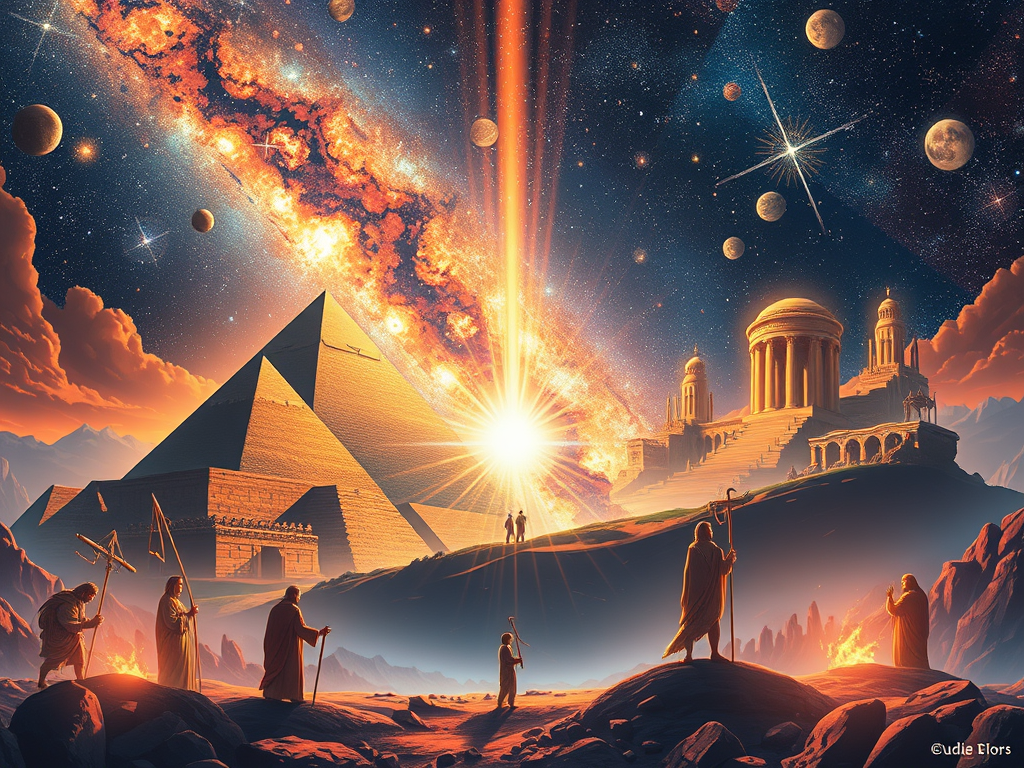
Ask anyone to recount the last five years, and their face clouds with confusion. COVID, riots, lockdowns, mandates, and elections have fogged recent memory. If five years blur, imagine six millennia. This “time confusion” lets us forget God’s plan since Creation. My fix: collapse time, shrinking gaps between history’s landmarks to reset our grasp of His story. A 30,000-foot view of 6000 years reveals His faithfulness and purpose.
Buckle up, reader. We’re sprinting from Creation’s spark to today’s chaos, picking moments that scarred humanity’s soul. These aren’t just dates – they’re history’s hinges, where empires rose, faiths clashed, and the world tilted. I’ve walked many of these places, felt their weight, and trust me, history’s a pulse still beating.
4000-ish BC: Creation
God spoke, and the world began (Genesis 1:1). No witnesses, just divine command crafting stars, seas, and souls. The start of human history placed humanity on a stage of free will and consequence. Old Earth skeptics scoff, but Genesis’ math holds, and light shone before darkness crept in.
40th Century BC: The Fall
Adam and Eve’s bite broke paradise (Genesis 3). Sin brought shame, toil, and death, severing our direct line to God. Every war, greed, and redemption echoes this garden disobedience. God’s promise of a Savior (Genesis 3:15) began His plan to mend our mess.
39th–31st Centuries BC: Noah’s Covenant
Sumerians birthed cities and cuneiform (c. 3500 BC), but God’s covenant with Noah post-Flood (c. 3000 BC, Genesis 9) reset humanity. These foggy centuries saw tribes become nations under His promise.
30th Century BC: Sumerian City-States
Uruk’s (modern-day Iraq) rise (c. 3100 BC) brought urban life and writing, turning chaos into order and setting the stage for empires.
29th–24th Centuries BC: Abraham’s Call
Egypt’s Great Pyramid (c. 2630 BC) glorified human kings, but Abraham’s call (c. 2000 BC, Genesis 12) launched God’s covenant with Israel, shaping true faith’s foundation.
23rd–20th Centuries BC: Exodus
Hammurabi’s Code (c. 1750 BC) brought human order to Babylon, its laws carving justice into stone. But God’s Ten Commandments, given to Moses at Sinai (c. 1446 BC, Exodus 20), tower above it – divine truth etched by the finger of God. The Exodus birthed Israel, and these commands, not man’s decrees, forged the West’s moral core, revealing God’s holy standard for His covenant people.
19th–16th Centuries BC: Judges
Israel’s judges (c. 1200 BC, Judges 2) held a fledgling nation together, guiding it through chaos by God’s hand.
15th–11th Centuries BC: David’s Kingdom
David unified Israel (c. 1000 BC, 2 Samuel 5), making Jerusalem a spiritual hub, a beacon for God’s people.
10th Century BC: Solomon’s Temple
Solomon’s Temple (c. 957 BC, 1 Kings 6) was God’s dwelling among His people. Its glory and later fall (586 BC) fueled prophetic hope.
9th–6th Centuries BC: Exile
Babylon’s conquest of Judah (586 BC, 2 Kings 25) exiled God’s people, yet prophets like Ezekiel and Daniel kept hope alive. Persia’s rise (c. 550 BC) showed empires fade, but God endures.
5th Century BC: Greece’s Golden Age
Athens’ democracy and philosophy (c. 450 BC) seeded the West’s obsession with reason, still shaping debates on justice.
4th Century BC: Alexander’s Conquest
Alexander (c. 330 BC) Hellenized the world, spreading Greek culture and language – God’s providence preparing the world for His Word in Greek.
3rd Century BC: Rome’s Rise
Rome’s First Punic War (264–241 BC) marked its ascent, setting a stage for Christ in a Roman-ruled Judea.
2nd Century BC: Maccabean Revolt
The Jewish revolt (167–160 BC) defended faith, rededicating the Temple (Hanukkah’s origin), proving God’s people could stand firm.
1st Century BC: Caesar’s Rome
Julius Caesar’s fall (44 BC) birthed Rome’s empire, paving the way for Augustus and a Savior’s arrival.
1st Century AD: Christ’s Birth, Life, Death and Resurrection
Jesus’ birth (c. 4–6 AD) and crucifixion (c. 30 AD, Luke 2–3) split history – God’s redemption in flesh. Rome’s roads (27 AD) carried the Gospel. I’ve walked them; they still bear faith’s weight.
2nd Century AD: Christianity’s Spread
Despite Nero’s persecutions, Christianity surged (c. 100–200 AD). Polycarp’s martyrdom (156 AD) showed faith outburns Rome’s fire.
3rd Century AD: Rome’s Crisis
Rome’s chaos (235–284 AD) couldn’t stop Christianity’s growth. Empires fall; God’s plan stands.
4th Century AD: Constantine’s Conversion
Constantine’s vision (312 AD) and Edict of Milan (313 AD) made Christianity Rome’s faith, though the combination of power and faith tainted purity.
5th Century AD: Rome’s Fall
The Visigoths sacked Rome (410 AD), and the West fell (476 AD). The Church stood as light in the Dark Ages’ rubble. Special thanks goes to Irish monks who played a significant role in preserving recorded history and the Bible during the Dark Ages.
6th Century AD: Justinian’s Code
Justinian’s laws (529–534 AD) and Hagia Sophia preserved faith and order amid shifting empires.
7th Century AD: Islam’s Rise
Muhammad’s death (632 AD) spread Islam’s falsehoods through conquest, from Mecca to Spain. I’ve sat in Middle Eastern mosques, felt the darkness of lies that deny Jesus as God’s only way (John 14:6).
8th Century AD: Charlemagne’s Coronation
Charlemagne’s crowning (800 AD) fused faith and power, birthing a fragile Europe.
9th Century AD: Viking Raids
Viking raids (c. 793–900 AD) forced unity among European kingdoms, but their voyages opened trade routes, stretching Europe’s horizons.
10th Century AD: Otto I’s Empire
Otto I’s coronation as Holy Roman Emperor in Rome (962 AD) revived the Holy Roman Empire, anchoring Christendom in a time of chaos.
11th Century AD: Great Schism
The East-West Schism (1054 AD) split Christianity into the Roman Catholic and Eastern Orthodox churches, fracturing unity and shaping today’s divided churches.
12th Century AD: Crusades Begin
The First Crusade (1096–1099 AD) clashed faiths. I’ve walked Jerusalem’s streets countless times; those battles still whisper.
13th Century AD: Magna Carta
Magna Carta (1215 AD) seeded constitutional law, planting ideas of rights that shape democracies.
14th Century AD: Black Death
The Black Death (1347–1351 AD) shook faith and economies, birthing a new social order.
15th Century AD: Gutenberg’s Press
Gutenberg’s press (c. 1450 AD) spread Bibles, sparking reformations. Ink outlasted swords.
16th Century AD: Reformation
Luther’s 95 Theses (1517 AD) birthed Protestantism, reshaping faith and culture in a fiery clash.
17th Century AD: Scientific Revolution
Galileo’s telescope (c. 1610 AD) and Newton’s laws (1687 AD) rewrote our cosmic place, reason challenging faith.
18th Century AD: American Revolution
The Declaration of Independence (1776 AD) declared governments serve people. Independence Hall feels humbling, fragile.
19th Century AD: Industrial Revolution
Steam and factories (c. 1800–1850 AD) remade society, progress costing sweatshops and smog.
20th Century AD: World Wars
World Wars I (1914–1918) and II (1939–1945) redrew maps, birthing the nuclear age. Hiroshima’s scars (1945) warn of our destructive power.
21st Century AD: 9/11 and Digital Age
The 9/11 attacks (2001) weaponized ideology. The digital age and AI (c. 2000–2025) flooded us with information, yet fractured truth, breeding a trust deficit.
What Now?
History’s light and shadow unveil God’s plan through the undulations of history. I’ve tread Iraq’s sands, Egypt’s Pyramids, Rome’s roads, London’s streets, Jerusalem’s stones, Hiroshima’s parks – where history’s hinges turned, revealing God’s redemptive plan (Romans 8:22). These places whisper God’s love. Collapsing time reveals with clarity Christ’s life, death, and resurrection as the true light piercing history’s darkness, urging us to live with purpose and clarity in faith.
 The Global Nexter