
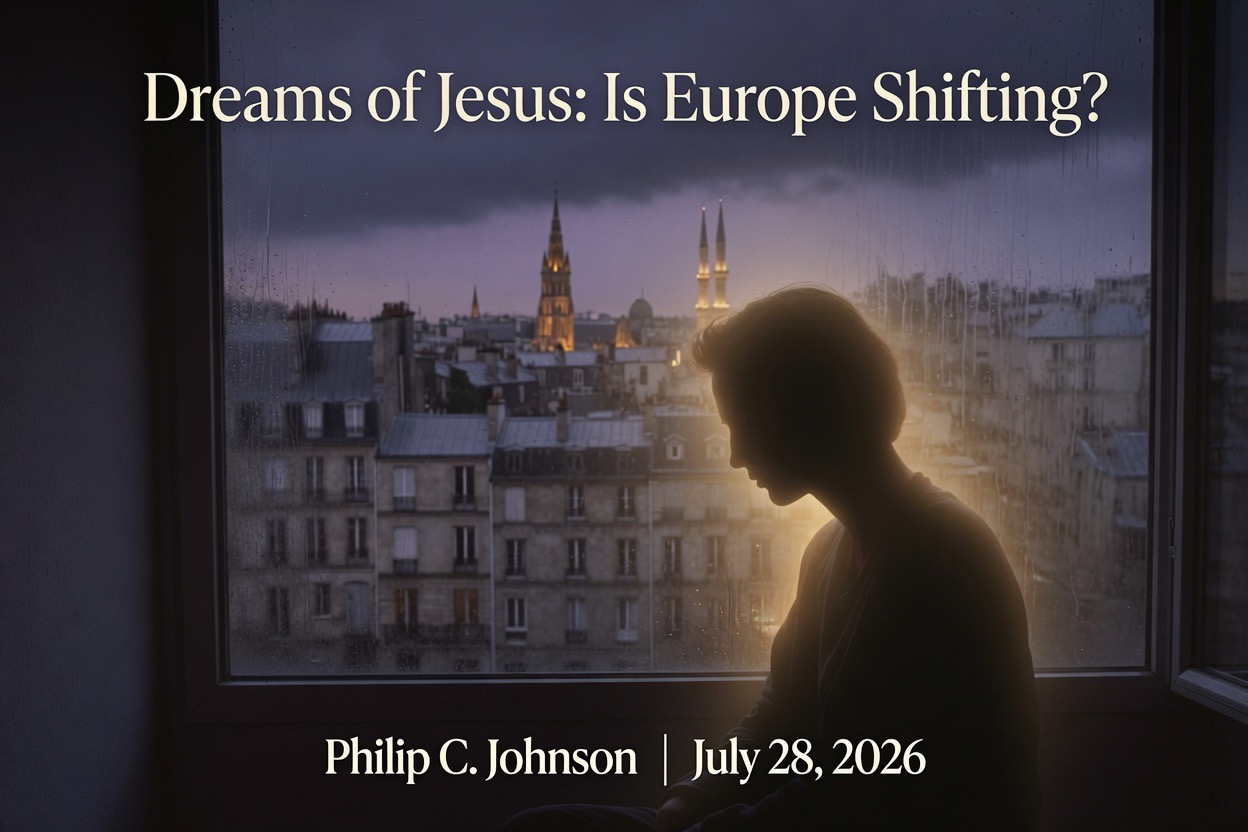
Philip C. Johnson | July 28, 2026
Personal Encounters with Dreams of Jesus
For years, I’ve heard the stories of Muslims in Europe and in Muslim-majority countries who described dreams in which Jesus appeared to them. In my own work in these parts of the world, I have come across this first-hand. They weren’t looking for arguments or theology at first. They were looking for what the dream meant. Those conversations always led to the Gospel and to questions about forgiveness and identity. These encounters feel deeply personal and real. They happen more than many in the West expect.
Is Europe turning back toward Christianity?
Here’s what I want to say before anything else gets in the way. The individual conversions are real, and they matter more than any statistic can capture. But the broader claim that some are making, that Europe is turning a demographic and cultural corner back toward Christianity, does not hold up against the numbers. Those two things are not in tension. God works in one soul at a time and always has. The West’s demographic and cultural trajectory is a separate question, and pretending the first proves the second does not serve anyone.
Cultural commentators and YouTubers like Steve Turley have picked up on the conversion stories and framed them as evidence the tide is turning. In one of his recent videos, he highlighted what he calls the fastest Muslim conversions to Christianity in Europe, pointing to France, Sweden, and Brussels. This fits his longer running argument, laid out over several books, that a Christian resurgence is already underway and a coming Christian majority is more than wishful thinking. That is not a small claim. It is a specific, falsifiable one about where the numbers are actually heading, and it deserves to be tested against the numbers rather than against the stories alone. I’ve walked the streets in France, Brussels, and Sweden myself, and I’ll focus mainly on France here, since that’s where the data is clearest to me, along with the pattern among the Iranian diaspora that keeps coming up in this conversation.
The Hopeful Side Deserves a Real Look First
Start with France, since it carries the clearest data. Priests working with converts describe growth in certain dioceses as newly exponential, a word Catholic outlets do not use loosely. One Paris area ministry reported that 10 to 20 percent of recent Easter baptisms involved people coming out of Muslim backgrounds. But set that next to the country’s Muslim population of roughly five to six million, and the limits of the story show up fast. Conversions to Christianity, real and increasing in certain Catholic and Protestant settings, still number in the low thousands per year at most across the estimates I could find. In the same window several thousand people convert to Islam annually in France. The exponential growth Catholic priests are describing is exponential against a small starting base, which is exactly how percentages can look dramatic while the headcount stays modest.
Among Iranian exiles the shift toward Christianity is especially visible, though it’s worth being clear about what that migration represents. Many already carried deep skepticism toward the regime and its version of Islam before they left, and in European cities they find Persian speaking fellowships and, for a meaningful number, a new Christian identity. That movement traces back decades, underground and largely invisible, and it has continued even now while the United States remains at war with the Iranian regime. Mission researchers tracking those underground networks inside Iran itself estimate growth from a few hundred after the 1979 revolution to figures ranging from several hundred thousand to as high as one to three million today, depending on the source. That growth has unfolded under real persecution, and it deserves to be told straight, without inflation and without dismissal. But it’s a diaspora story, not a story about Europe. Iranian converts arriving in European cities aren’t reshaping European institutions, politics, or public life the way ongoing Muslim immigration is. The two trends matter, but they run on entirely different tracks.
The Demographic Reality and Secular Trends
This is where Turley’s larger claim runs into trouble. Pew Research tracking religious change across Europe from 2010 to 2020 showed Christians declining both in absolute numbers and as a share of the population. The religiously unaffiliated grew sharply. Muslims increased through migration and natural growth. Religious switching played a role in the totals, but the dominant pattern by far was people raised Christian stepping away from any religious identity, not toward one. Net movement from Muslim to Christian backgrounds stayed small against the larger inflows. The absolute number of new Christians coming out of Muslim backgrounds is real but modest set against the scale of recent migration into Europe.
Those percentages can look impressive when the starting base is tiny, and Turley leans on that kind of framing more than once. The actual headcount tells a different story once you set it against millions of new Muslim residents and the steady secular drift among native Europeans. Europe is not experiencing a broad reclamation of Christian identity. Secularization keeps shaping institutions, education, family patterns, and public life. Christian affiliation is thinning across most of the West even as committed pockets remain or form among migrants and in parts of Eastern Europe.
And here is the part I don’t think we should soften. Weighed against each other, the cultural and demographic push of Islamic influence into Europe and the West looks more muscular, and more consequential, than the numbers turning to Christ, at least across Europe and the West taken as a whole. That imbalance should concern us. Every single life given to Christ matters and is worth real excitement, no matter how the math around it shakes out. But celebrating those individual stories while waving off the scale of Islamic influence reshaping the continent is wishful thinking, and it is wishful thinking bought at our own expense.
On the Ground in Muslim Enclaves: Paris and Brussels
My recent visits to Muslim enclaves in the Paris and Brussels suburbs brought this home in stark terms. These are places where terrorist plots were hatched and where surviving attackers hid after devastating attacks. Walking those streets, you would be hard pressed to understate the impact of Islam on Europe. Parallel communities, cultural separation, and visible signs of Islamist influence create tensions that affect daily life, social cohesion, women’s safety, and basic freedoms. The changes are not subtle. They shape neighborhoods, schools, and public discourse in ways that challenge the historic character of Western societies. Nothing in the conversion data I have cited changes what those streets look like today.
Individual Lives and God’s Work Amid the Trends
None of this diminishes what God is doing in individual lives, and He has always worked that way. Conversions matter spiritually far beyond what they do to a headcount. Every person who moves from Islam to Christianity through genuine conviction represents a profound shift in allegiance and hope. The dreams I heard about were not marketing. They were often the starting point for costly decisions, paid for in family tension and social cost. Those stories will keep happening, and they deserve to be told without exaggeration and without being waved away because they are inconvenient to a larger narrative in either direction.
Where Christianity is Really Booming
The strongest Christian growth today is in the Global South and parts of Asia, where both the numbers and the cultural confidence are rising together. In Europe the picture is less optimistic. A relatively small number of people are coming to Christ. A much larger number of people, and a much larger cultural force, are reshaping Europe in the other direction. Both are real. They are not the same size. Pretending otherwise does not serve clear thinking about what is actually happening in the places where many of us live and work.
What stands out most from the conversations I have had is how ordinary the search often feels. Someone encounters something unexpected, in a dream or through a relationship, and they follow it wherever it leads. Those divine-directed elements will outlast any set of statistics I can put in front of you. The question for those of us who care about both the Christian faith and the future of the West is whether we can hold the numbers and the stories in the same hand without letting either one erase the other.

