
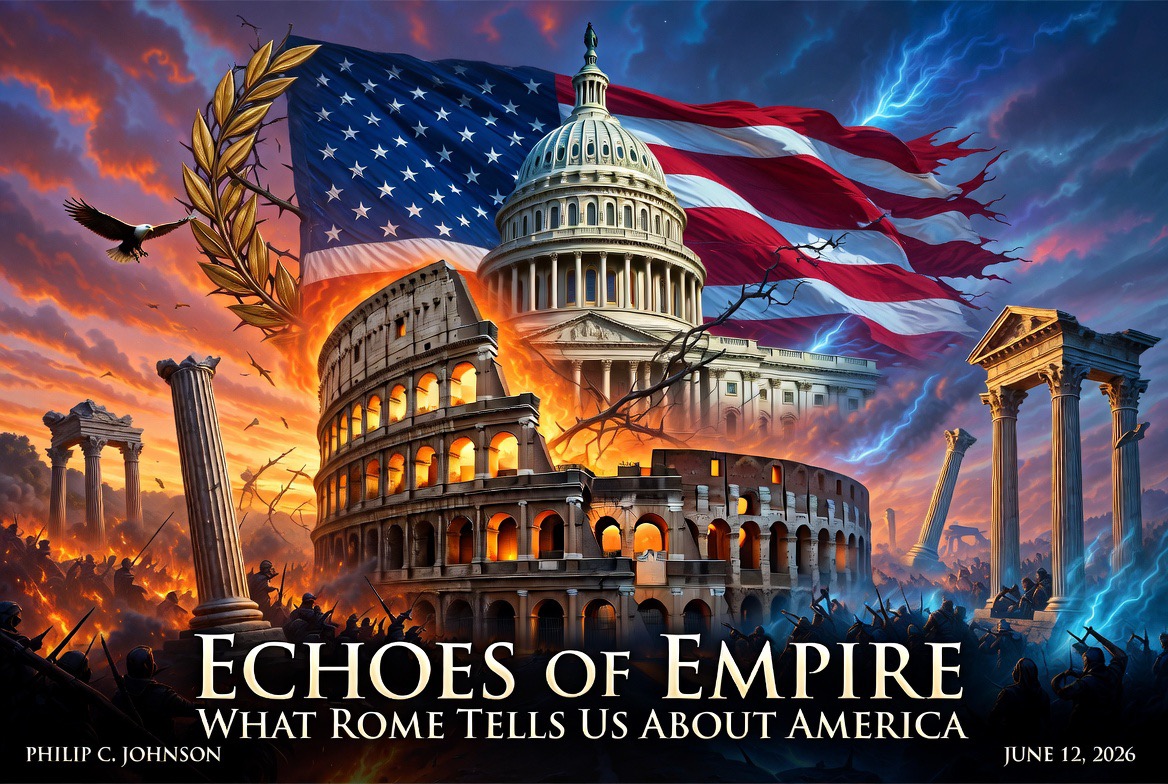
Philip C. Johnson | June 12, 2026
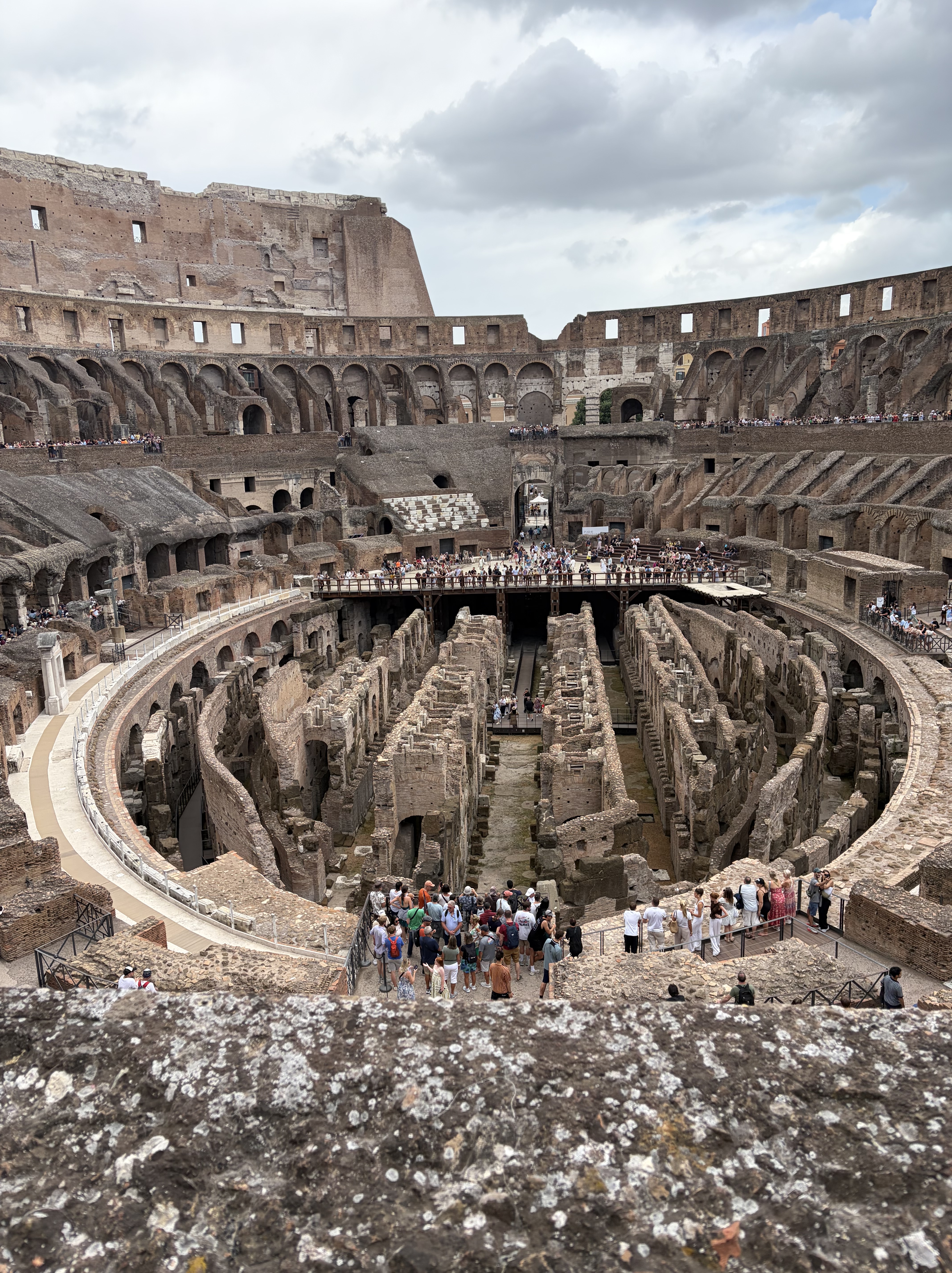
Earlier this month I was standing in Rome with a group of adult travelers, teaching inside the ruins. The Forum. The Colosseum. The Arch of Titus. You cannot stand in those places and treat them as backdrop. The stones demand something from you. They are not simply old. They are instructive, and if you are paying attention, they are sobering.
What I kept returning to, even before we stood amongst these ancient stones, was that these ruins are not a monument to what Rome achieved. They are a record of what Rome lost. A civilization that rose through discipline and sacrifice, that gave the ancient world its most sophisticated system of law and governance, hollowed itself out from within. Gradually. Predictably. And with no shortage of people who saw it coming and said so. Many observers look at the United States today and see the same trajectory: moral exhaustion, political fragmentation, economic strain, and a culture that once knew truth and has made a deliberate choice to suppress it. This is not cheap political rhetoric. It is a sober pattern of civilizational life and death, illuminated by both history and Scripture.
From Republic to Empire: The Shift That Changed Everything
Rome did not begin as an empire. For nearly five centuries, from 509 to 27 BC, the Roman Republic operated on principles that were genuinely distinctive in the ancient world: representative governance, separation of powers, rule of law, and a deep institutional suspicion of monarchy. These were real achievements. They deserve the credit they get.
But let’s be honest about what the Republic actually was. Slavery was foundational to its economy. Conquest was brutal and largely unapologetic. The Senate was frequently corrupt and aggressively self-serving. Class conflict between patricians and plebeians ran for centuries and never resolved. What made the Republic “virtuous” compared to its neighbors was less the character of its men than the structure of its system, a constitution that resisted tyranny even when the people inside it didn’t particularly deserve the credit.
That structure eventually gave way. The late Republic fractured under civil wars, populist strongmen, and the slow erosion of norms that had once seemed permanent. Julius Caesar’s assassination in 44 BC left a power vacuum that his heir Octavian and his lieutenant Mark Antony tried to fill by dividing the world between them. Dividing the world is the kind of arrangement that works right up until it doesn’t.
Antony’s alliance with Cleopatra gave Octavian the weapon he needed. He recast Antony not as a rival but as a Roman traitor seduced by an eastern queen. War was declared, and on September 2, 31 BC, their fleets met off the Greek coast at Actium. The battle ended not with heroism but with abandonment. Cleopatra fled. Antony left his own men to follow her. Both were dead within a year.
Octavian returned to Rome as its unchallenged master, received the title Augustus, and the Republic quietly became an Empire. The Senate still met. Elections were still held. The forms survived; the substance did not. Real power had centralized irreversibly, and everyone with any sense knew it.
History rarely announces its turning points. That one did. The imperial machine forged at Actium is the same one that would, within a generation, govern Judea, crucify Jesus, and level Jerusalem in AD 70.
The Peace That Cost Everything
What followed was the Pax Romana, roughly two centuries of relative stability, safe roads, open sea lanes, and enforced order across the Mediterranean world. It was genuinely impressive. It was also entirely the product of autocratic rule, not republican freedom.
This is the irony worth sitting with. The liberty that defined Rome at its best could not sustain the peace Rome needed. Autocracy delivered what democracy had failed to hold together. And the peace, once established, was maintained not by civic virtue but by bureaucratic entrenchment and the steady, quiet erosion of the freedoms that had made Rome worth governing in the first place. Not confiscated all at once. Consumed one mouthful at a time, while the citizens enjoyed the roads and the grain and the games and told themselves things were basically fine.
Not Silent at All: God’s Preparation for the Gospel
Here is what most people miss about this period. Between Malachi, the last Old Testament prophet, writing around 430 BC, and the birth of Jesus around 6 to 4 BC, lie roughly 400 years Bible readers call the “silent years.” No new canonical Scripture. No prophetic voice. But these centuries were anything but quiet. God was preparing the world for the Gospel with the patience and precision of someone who knows exactly what He is doing.
Alexander the Great’s conquests spread Koine Greek across the known world, the very language in which the New Testament would be written. Jewish scholars in Alexandria translated the Hebrew Scriptures into Greek, putting them within reach of Gentiles everywhere. Synagogues spread throughout the Hellenistic world, creating natural staging points for early missionaries. Then Rome’s roads and sea lanes became the infrastructure of the Gospel’s expansion. Paul could travel from Jerusalem to Rome with a speed and safety that would have been unthinkable a century earlier.
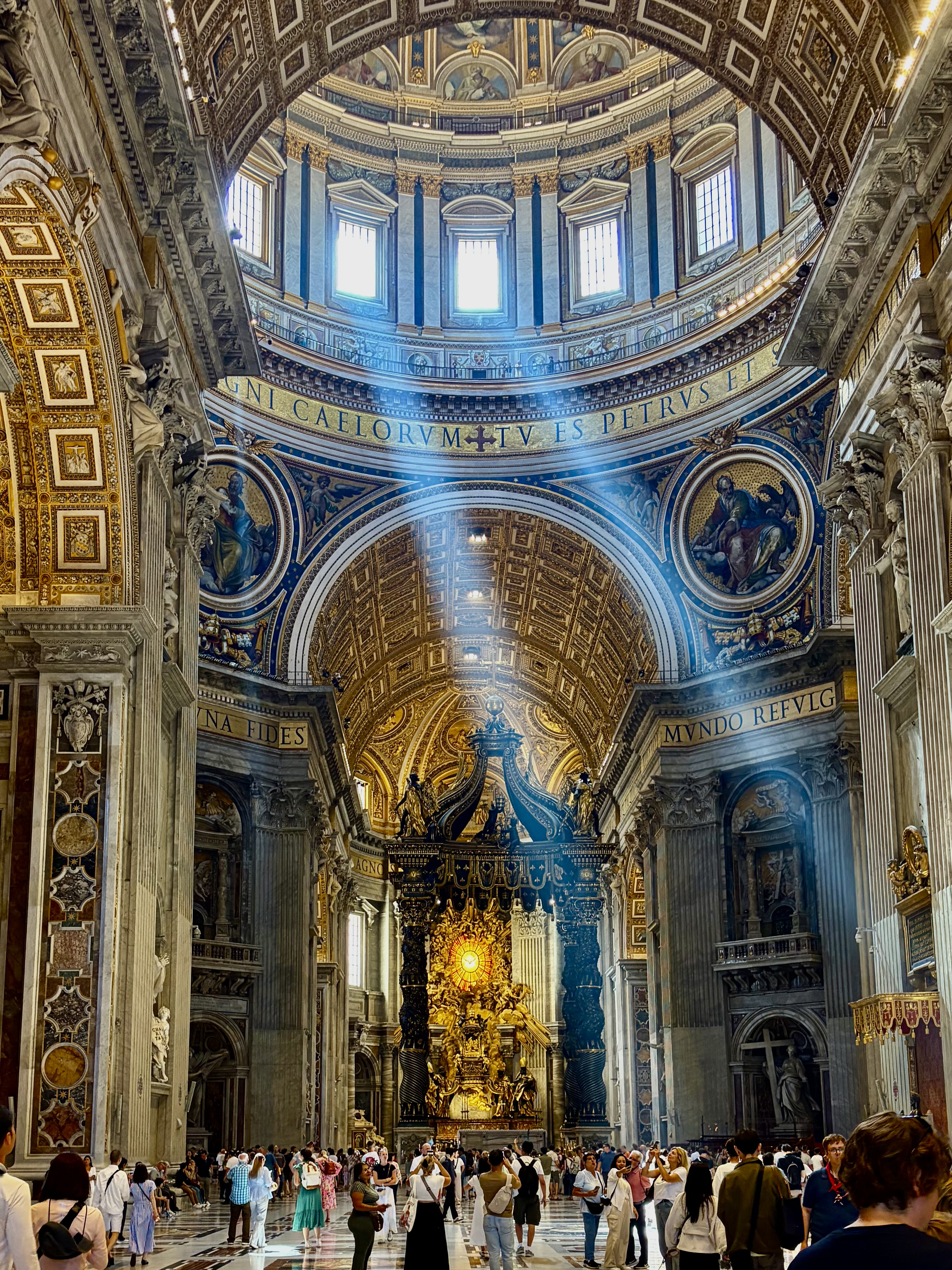
What looked like ordinary political history was, in retrospect, praeparatio evangelica. Divine preparation. As Paul wrote to the Galatians: “when the fullness of time had come, God sent forth his Son” (Galatians 4:4, ESV). The stage had been centuries in the making. Caesar thought he was building an empire. He was building a delivery system.
Paul’s Diagnosis, and Ours
Around AD 57 to 58, writing from Corinth, Paul composed his letter to the Roman church, a congregation he had never visited, already famous for its faith, surrounded by an empire in moral freefall. In Romans 1:18-32 he delivers a cultural diagnosis that reads like this morning’s newspaper.
He describes a society with full access to the truth about God, written into creation itself, that chose to suppress it. They exchanged the glory of the immortal God for idols of created things. And three times Paul says God responded by giving them over: to impurity, to dishonorable passions, and finally to a debased mind approving everything Scripture forbids.
Rome exemplified the pattern. So does the United States. A nation blessed unlike almost any other in history, with the full revealed Word of God, with Gospel influence woven into its founding assumptions, with the evidence of the Creator visible in creation, now mirrors the same trajectory. Truth suppressed at scale. Biological reality, documented history, and moral authority traded away for the idols of self and progress. And a culture that doesn’t merely practice what Paul described, but applauds those who do.
Rome fell. Not in a day, and not without warning. The question for Americans, and particularly for the American church, is not whether the parallel is real. It plainly is. The question is what faithful people do when they find themselves living inside it.
Here is the last thing the ruins will tell you, and it is not a grim thing. Stand in the Forum long enough and you notice what is missing: the empire. The power that crucified Jesus, leveled Jerusalem, and fed believers to lions for entertainment is now a field of broken columns where tourists eat gelato in the shade. And the letter Paul wrote to a small, anxious church in that city is still being read this today, in every language on earth. “The grass withers, the flower fades, but the word of our God will stand forever” (Isaiah 40:8, ESV). Empires fall on schedule. The Word does not. The church in America should grieve what is being lost, contend for what can still be saved, and remember which of those two kingdoms it actually belongs to.
 The Global Nexter