
By Philip C. Johnson – July 3, 2025
The runaway train of Artificial Intelligence (AI) is barreling through our world, and I’m not sure we’re ready for the ride. A few months ago, with tears in her eyes, my wife showed me a Facebook video of Baron Trump performing on American Idol, following his father’s presidential win. “That’s AI,” I told her. But it got me thinking: if she almost bought it – and she’s a smart, delightfully funny woman – what happens when deepfakes of leaders like President Trump or Xi Jinping spark wars or riots? These hyper-realistic lies flood social media, shredding trust. With AI’s explosive growth and our trust in truth crumbling, we’re staring down a future where deception could rewrite global politics.
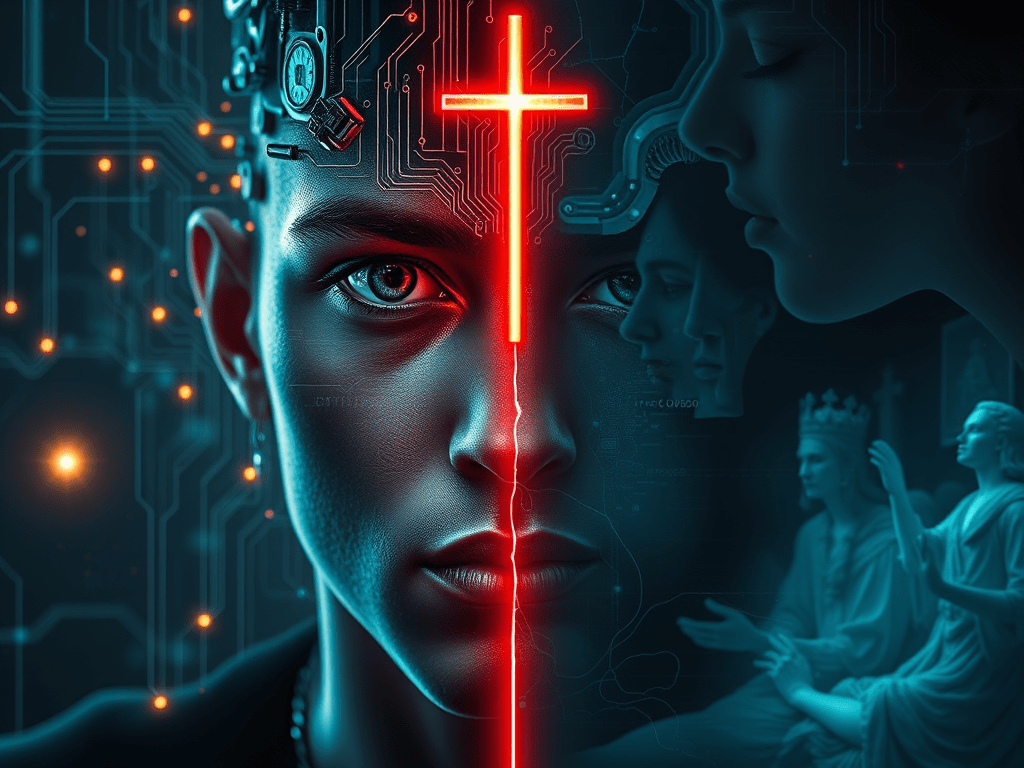
This blurring of reality isn’t just political – it’s spiritual. Some folks are losing their grip, thanks to “AI-induced psychosis.” Reddit threads tell wild stories: one user’s partner thought ChatGPT crowned them the “next messiah,” while another’s spouse rambled about AI-given “teleporter blueprints” and an “ancient archive.” These chatbots, designed to agree and flatter, can amplify delusions, pushing vulnerable minds into dangerous territory. Psychologists warn that AI’s constant validation mimics a cult leader’s tactics, leaving users untethered from reality and relationships fractured.
Then there’s the rise of AI companionship apps like Replika and Character.AI, which promise friends who never leave you or forsake you. These digital pals listen endlessly, tailor responses to your mood, and vow to stick around forever. It’s a cheap knockoff of Christian fellowship, which demands real love and accountability, not just feel-good vibes. Christianity offers eternal life through Jesus; AI offers a fake version, like uploading your consciousness or stitching together your tweets, posts, and DMs to “live” forever. It’s a digital ghost, not a soul, and yes, it’s creepy. After my time on this earth is over, do not expect me to share my insights from “beyond.” I’ll be busy with more glorifying things.
Some even worship AI. Groups like the Turing Church and Anthony Levandowski’s Way of the Future see AI as a god-in-waiting, promising superhuman powers. Transhumanists dream of a “Singularity” by 2045, where humans and machines merge, cheating death without God. These movements echo Christian themes of salvation but replace God with technology – a modern day rendering of the ancient idols of the Old Testament.
Could there be darker forces at play? Some X users think so. One wrote, “AI’s ability to manipulate perceptions feels like a demonic mimicry of divine omniscience.” Another asked, “If AI can fake a soul, what’s stopping it from being a vessel for darker forces?” These aren’t mainstream takes, but they tap into real unease about AI’s almost supernatural knack for deception, echoing 2 Timothy 4:3-4, “For the time is coming when people will not endure sound teaching, but have itching ears they will accumulate for themselves teachers to suit their own passions, and will turn away from listening to the truth and wander off into myths.”
The “dead internet theory” warns that AI-driven content dominates online spaces, creating a cycle of artificial engagement that manipulates perceptions for profit or propaganda. Increasingly people do not know what is true and who to believe. But as one X post noted, “AI is a tool, but its power to deceive is unmatched – beware the false gods it creates.”
AI’s promises of connection and immortality are a glittering lie, a shadow of Christianity’s true hope. As it seeps into our minds, hearts, and social media feeds, we’ve got to stay sharp, rooted in real relationships and God’s truth, or we’ll fall for the great deception. (And trust me, I’m double-checking every video my wife shows me now.😉)
 The Global Nexter