
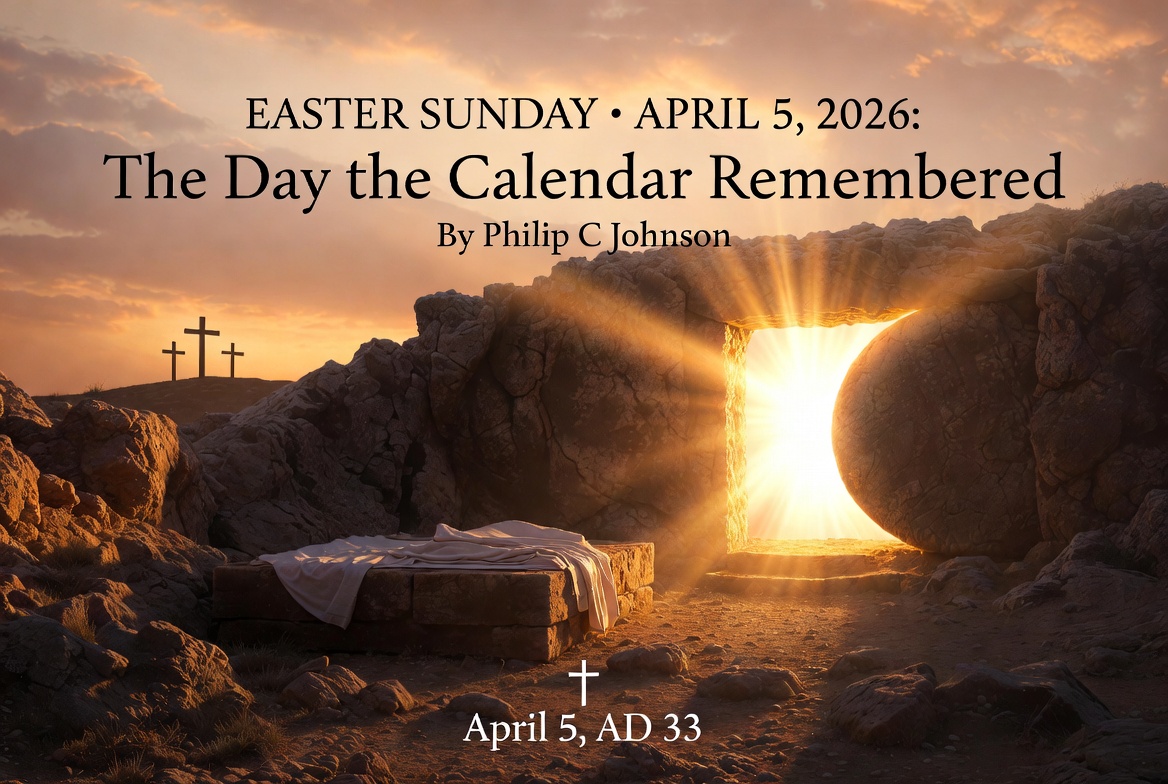
By Philip C Johnson, April 5, 2026
This Easter Sunday falls on the exact date many scholars believe Christ rose from the dead — April 5, AD 33. Here’s why that matters, what the prophets said, and what endures beyond all the calendars.
Today is Easter. That sentence is simple enough. But this year, something quietly remarkable is happening that most churchgoers will never hear about from the pulpit — and that biblical scholars, prophecy watchers, and historians are noticing all at once. This Easter Sunday, April 5, 2026, falls on the same calendar date that many scholars believe marked the Resurrection itself.
Good Friday also lines up on April 3 in both AD 33 and 2026, completing the alignment of the key days of Passion Week. It is the kind of convergence that quietly stirs the imagination.
Pinning the Date
For centuries, the precise date of the Crucifixion was treated as unknowable. But scholars working at the intersection of history, astronomy, and Scripture have narrowed it down considerably. Dr. Jeremiah Johnston, apologetics pastor at Prestonwood Baptist Church, is among those who hold that Jesus was crucified on Friday, April 3, AD 33, and rose from the dead on Sunday, April 5. He is in notable company.
Scholars Andreas Köstenberger and Justin Taylor, writing for First Things, laid out a careful case converging on the same date: the 15th year of Tiberius Caesar’s reign as recorded in Luke 3, multiple Passovers in John’s Gospel requiring a ministry of at least three years, the requirement that Nisan 14 fall on a Friday, and astronomical data showing that only two years in the governorship of Pontius Pilate satisfy all conditions — AD 30 and AD 33. The majority of evidence, they concluded, points to AD 33.
A non-Christian historian named Phlegon of Tralles, writing around AD 150, even recorded an unusual darkness at noon that many scholars connect to the Crucifixion. He placed it in the fourth year of Olympiad 202 — the spring of AD 33. The threads converge.
“In the fourth year of Olympiad 202, an eclipse of the sun happened, greater and more excellent than any that had happened before it; at the sixth hour, day turned into dark night.”
— Phlegon of Tralles, ~AD 150
How Rare Is This?
Easter is what liturgists call a “movable feast” — calculated each year as the first Sunday after the first full moon following the spring equinox. Over a 500-year span, it wanders across 35 possible dates between March 22 and April 25. April 5 occurs roughly 21 times in those 500 years — not the rarest Easter date, but far from the most common.
What makes 2026 stand out is the full alignment: Easter Sunday landing precisely on the proposed resurrection date of April 5, AD 33, with Good Friday falling on April 3. It happened as recently as 2015 and will occur again in 2037. Still, seeing the calendar echo the very week of the Passion in this way feels like a gentle reminder from history itself.
The alignment is confirmed: this is the 1,993rd anniversary of the death and resurrection of Jesus Christ. Mark your math: 2033 will be the 2,000th anniversary — a round number that has prophecy-watchers already paying attention.
The World at This Moment
The date coincidence arrives against a backdrop that would have felt familiar to readers of the Old Testament prophets. The United States is at war with Iran. NASA’s Artemis program is working to return humans to the moon. The geopolitical order is reshaping itself in real time, with Russia, China, Turkey, and a battered but not broken Iran maneuvering against Western influence and against Israel
For students of biblical prophecy, that list of nations is not incidental. It is a nearly word-for-word inventory from Ezekiel 38.
What Ezekiel Wrote: Ezekiel 38:5-6
“Persia, Cush, and Put will be with them, all with shields and helmets; also Gomer with all its troops, and Beth Togarmah from the far north with all its troops — the many nations with you.”
Speaking of a coalition assembled under “Gog of the land of Magog,” biblical scholars have long mapped Ezekiel’s ancient names to their modern counterparts:
– MAGOG / ROSH = Russia
– PERSIA = Iran
– BETH TOGARMAH = Turkey
– CUSH = Sudan / Ethiopia
– PUT = Libya
– KINGS OF THE EAST = China (Rev. 16:12)
The alignment in 2026 is striking. Russia and Iran have conducted joint naval exercises. China purchases the vast majority of Iran’s exported oil, providing the economic lifeline that sustains the regime. Turkey, once a NATO ally, has increasingly pursued its own course. These are the exact nations Ezekiel named — roughly 2,600 years ago — as the coalition that would one day move against Israel.
Separately, Jeremiah 49 contains a prophecy about Elam — a region within ancient Persia, now part of Iran — that speaks of its scattering and, eventually, its restoration. Some prophecy scholars see in Iran’s current humiliation the first chapter of a longer story: a weakened Persia that does not disappear from the prophetic map but reconstitutes itself, nursing its grievances, and eventually joining the very coalition Ezekiel described.
It is worth stating plainly: good hermeneutics demands caution. Scholars across the theological spectrum disagree sharply on the timing of the Gog-Magog war — whether it precedes Christ’s return, occurs during the Tribulation, or unfolds in the Millennium. Not every news headline is a fulfillment. But the convergence of these nations, in this configuration, at this moment, is the kind of thing that causes serious Bible students to set down their coffee and read Ezekiel 38 again slowly.
The Weight of What Doesn’t Move
Calendars are interesting. Geopolitics is urgent. Prophecy is compelling. But there is something that predates all of it and outlasts all of it — and it happened, most scholars now believe, on a Friday in early April, 1,993 years ago.
A man who was also God hung on a Roman cross outside Jerusalem. He had taught for three years. He had healed the sick, raised the dead, and claimed — without apology and without qualification — to be the Son of God. His disciples had scattered. The Romans thought they had dealt with another would-be messiah, one of dozens recorded in first-century Judea. By nightfall he was buried in a borrowed tomb. And then, on Sunday morning — April 5, AD 33, by the best reckoning of scholarship — the tomb was empty.
The Apostle Paul, writing to the Corinthians, did not dress this up in mysticism: “If Christ has not been raised, your faith is futile.” He staked everything on a historical event. So did the disciples, most of whom died for their testimony that they had seen the risen Jesus. People die for things they believe. They rarely die for things they know to be fabrications.
Whatever one makes of the prophecies, the geopolitics, the lunar alignments, and the calendar coincidences — and they are worth making something of — the center of Easter is not a date. It is a Person. And His offer has not changed: freedom from sin, victory over death, and eternal life for anyone who trusts in Him.
Exactly 1,993 years ago — on the dates we are marking this very weekend — God, as Man, paid the price for our sins on the cross. He did not stay dead. He conquered death, and through Him we can have freedom from sin and the promise of eternal life.
Happy Easter.
✝
Philip C. Johnson is an educator, journalist, geopolitical analyst, and founder of Global Next (globalnext.org), an educational travel organization operating across Europe, Asia and the Middle East.
 The Global Nexter